This is default featured slide 1 title

Go to Blogger edit html and find these sentences.Now replace these sentences with your own descriptions.

This is default featured slide 2 title

Go to Blogger edit html and find these sentences.Now replace these sentences with your own descriptions.

This is default featured slide 3 title

Go to Blogger edit html and find these sentences.Now replace these sentences with your own descriptions.

This is default featured slide 4 title

Go to Blogger edit html and find these sentences.Now replace these sentences with your own descriptions.

This is default featured slide 5 title

Go to Blogger edit html and find these sentences.Now replace these sentences with your own descriptions.

Saturday, January 19, 2008

There are many different kinds of Buddhist monks, just as there re many different types of Buddhism. Their life and customs are different and unique, and each has a spiritual meaning. There is a certain code the monks must follow and certain rules that must be obeyed. Their daily life follows a strict schedule, and each monk's life revolves around meditation, the study of scriptures, and the taking apart in ceremonies. His daily life involves interaction with the community around him and with his fellow monks.

Each kind of monk has a different life style, as there are much unique kind of monks just as there are many different ways that they can live. Renunciate monks fall under one of two categories, those who live in a monastic community and those who live in a hermit like state, who are referred to as forest monks. The forest monk lives to the virtual dismissal of all activities non-related to the pursuit of enlightenment. Then there is the temple monk who is occasionally involved in lay community affairs, such as participating in Buddhist holy days. they are can also be involved in the teaching of novice monks, short-term monks, or laymen or laywomen.A temple monk’s pastoral activity is a transaction between monks and householders; this is where a monk confers merit upon a layman. In gratitude and respect the layman may offer food, money, and other everyday items or he could offer a ritual item such as a candle.

Thursday, January 17, 2008


Thursday, November 08, 2007

Tuesday, November 06, 2007

Theravada Monk and Festival


These pictures were taken during the Buddhist festival of ending the Buddhist rain retreat in Myanmar.

Thursday, August 30, 2007

How to be a good Buddhist

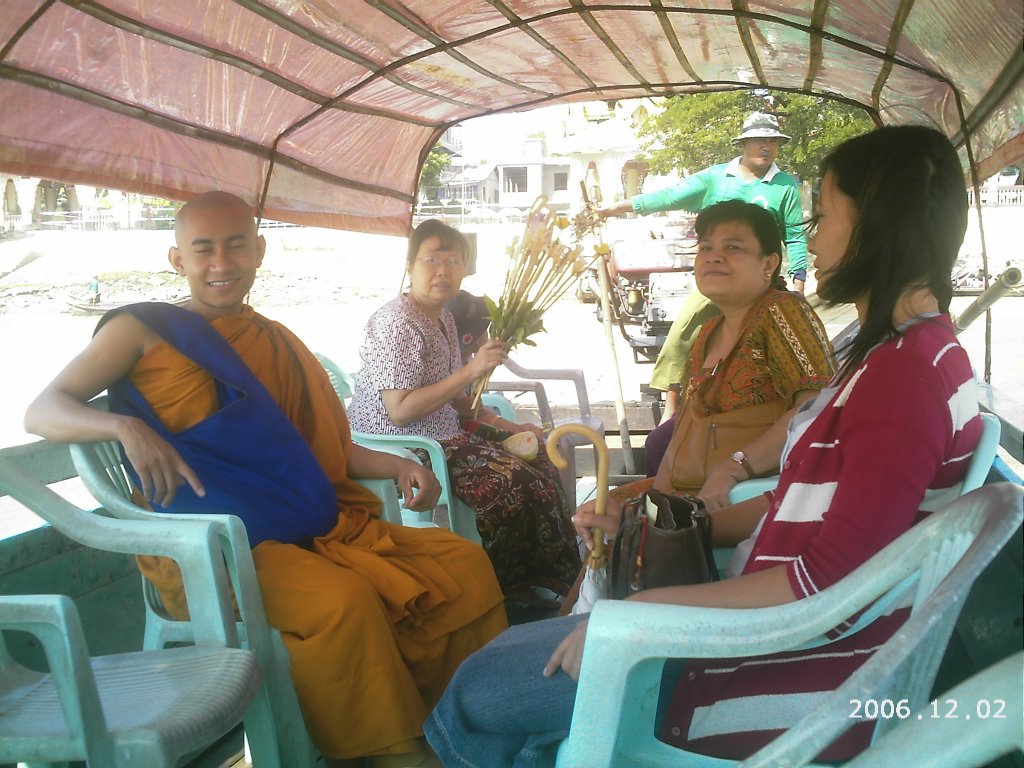
I with Novice from Loas ( right) and Indonesian Monk (left) took the picture with two Burmese pious devotees who had arranged the trip for us. They are so generous and kind. They often invite us to have meal and donate some offerings kindly and faithfully.

How Good a Buddhist Are You?

A simple question but not a simple one to answer. It all depends, of course, on what we mean by 'good'. Here are some suggestions on what I think a good Buddhist might be.

A good Buddhist is kind, compassionate, honest, open, giving, engages with some form of spiritual practice (meditation, for example) and adheres consistently to the precepts: abstaining from harming living beings, from taking what is not given, from sexual misconduct, from false speech and from imbibing intoxicating drink or drugs. A good Buddhist does not harbor thoughts of ill-will or lust, does not act selfishly, does not belittle the efforts of others. A good Buddhist constantly works at freeing the mind of its delusions.


Sunday, August 19, 2007


This is The Thai royal palace.
This picture was taken in Thailand during my vacation in April 01, 2007. It is called Chao Praya river located in the heart of Bankork, Capital city of Thailand.


Saturday, August 11, 2007


Friday, August 10, 2007

Tuesday, July 24, 2007


Wednesday, January 31, 2007

My University

Angkor wat,The world heritage, locates in Cambodia,Srok Khmer.
This is the International Theravada Buddhist Missionary University where i am studying Buddhist literature,Yangon,Myamar(Burma).

Sunday, January 28, 2007

some of my friends in Battambang

They are my friends staying at Kampheng monastery where i had ever stayed for more than 3 years, located in Battambang provice,Cambodia.

Sunday, January 21, 2007

Cambodian Royal Palace


Cambodian Royal Palace

Cambodia views


Sunday, December 24, 2006

Buddhism and Science


Western interest in Eastern religions, especially Buddhism, historically coincided with the rise of modern science and the corresponding perceived decline of religious orthodoxy in the West. Put simply: Modern science initiated a deep spiritual crisis that led to an unfortunate split between faith and reason—a split yet to be reconciled. Buddhism was seen as an "alternative altar," a bridge that could reunite the estranged worlds of matter and spirit. Thus, to a large extent Buddhism's flowering in the West during the last century came about to satisfy post-Darwinian needs to have religious beliefs grounded in new scientific truth.
As science still constitutes something of a "religion" in the West, the near-absolute arbiter of truth, considerable cachet still attends the linking of Buddhism to science. Such comparison and assimilation is inevitable and in some ways, healthy. At the same time, we need to examine more closely to what extent the scientific paradigm actually conveys the meaning of Dharma. Perhaps the resonance between Buddhism and Western science is not as significant as we think. Ironically, adapting new and unfamiliar Buddhist conceptions to more ingrained Western thought-ways, like science, renders Buddhism more popular and less exotic; it also threatens to dilute its impact and distort its content.

Saturday, December 23, 2006

shwe dagon pagoda


Burmese Buddha image style and Buddha's teaching


Buddha is the greatest scientist in the history of mankind." I have often heard this at bana sermons. This is completely wrong. Scientists are people who are constrained to work solely within and accept only, the knowledge generated by the scientific method. They generally reject knowledge generated by the other method. The Buddha did not use the scientific method and therefore he is not a scientist.
Of the two methods of acquiring knowledge available to the human being the Buddha used the right brain centered intuition method, where as the western approach to acquiring knowledge used the left brain method. The Buddha trained his mind to an extreme high state of enlightenment (Buddhahood) from where he could understand the true reality of nature in its totality. It is based on such knowledge that he propounded a philosophy which is most conducive to balanced and happy living which leads to living in harmony with others, living in harmony with nature, meaningful living devoid of stress, anxiety, jealousy and empty pride, ultimately ending up in a meaningful state full of bliss. That was over 2500 years ago. Science began much later.
Science is often explained as systematic formulated knowledge. It is knowledge needed to understand the phenomena that we observe and those that influence our lives. For the early man science represented a cumulative process of increasing knowledge and ability to understand what is around him. It also meant a sequence of victories over ignorance and superstition. During the time of the Buddha, science was still speculative explanation of common sense observations by intellectuals who devoted much of their time for thinking and understanding natural phenomena. Science helped to develop technology essential for producing things needed to make life more comfortable.
During the seventeenth century the French Mathematician Rene Des Cartes restricted the scope of science to only what is material by bifurcating the universe as matter (res extensa) and mind (res cogitans) and limiting science to the study of the former. The science that evolved on the basis of Cartesian bifurcation was confined to material objects within the limits of perception of human sensory organs which are unable to perceive anything that extended beyond three spatial dimensions.

My trip